Book Your Appointment


An Introduction to Psychodynamic Approaches: Freud’s Structures of Personality and Modern Applications
by Jumana Raggam
November 28, 2025
The psychodynamic approach aims to uncover the unconscious and early-life roots of psychological distress while exploring how these unresolved issues appear in a person’s present behaviour and emotional life. Originating from the theories of Sigmund Freud and later expanded by Carl Jung, Alfred Adler, and others, this approach helps individuals gain self-awareness and insight into the origins of their emotions, behaviours, and internal conflicts.
While the terms psychoanalysis and psychodynamic therapy are often used interchangeably, it is important to note that psychoanalysis refers specifically to Freud’s method, whereas psychodynamic therapy is a broader school of thought that encompasses Jungian, Adlerian, and later developments.
Key Concepts in the Psychodynamic Approach
Although some psychodynamic concepts are frequently referenced in popular media, they are often misunderstood or oversimplified. Below are the core components of this therapeutic approach.
1. The Unconscious Mind
The unconscious mind contains thoughts, memories, and emotions that are repressed or outside one’s awareness, yet still influence behaviour. Psychodynamic therapy supports clients in identifying these hidden patterns so they can better understand their reactions, relationships, and emotional difficulties.
2. Dream Analysis
Dreams are believed to express thoughts and emotions that are not accessible during waking life. In psychodynamic theory, dreams contain:
- Manifest content – the literal storyline and images of the dream
- Latent content – the hidden symbolic meaning beneath the surface
Therapists often focus on the latent content. For example, dreaming of losing control while driving may symbolise feeling overwhelmed or lacking direction in life.
Freud’s Structure of Personality
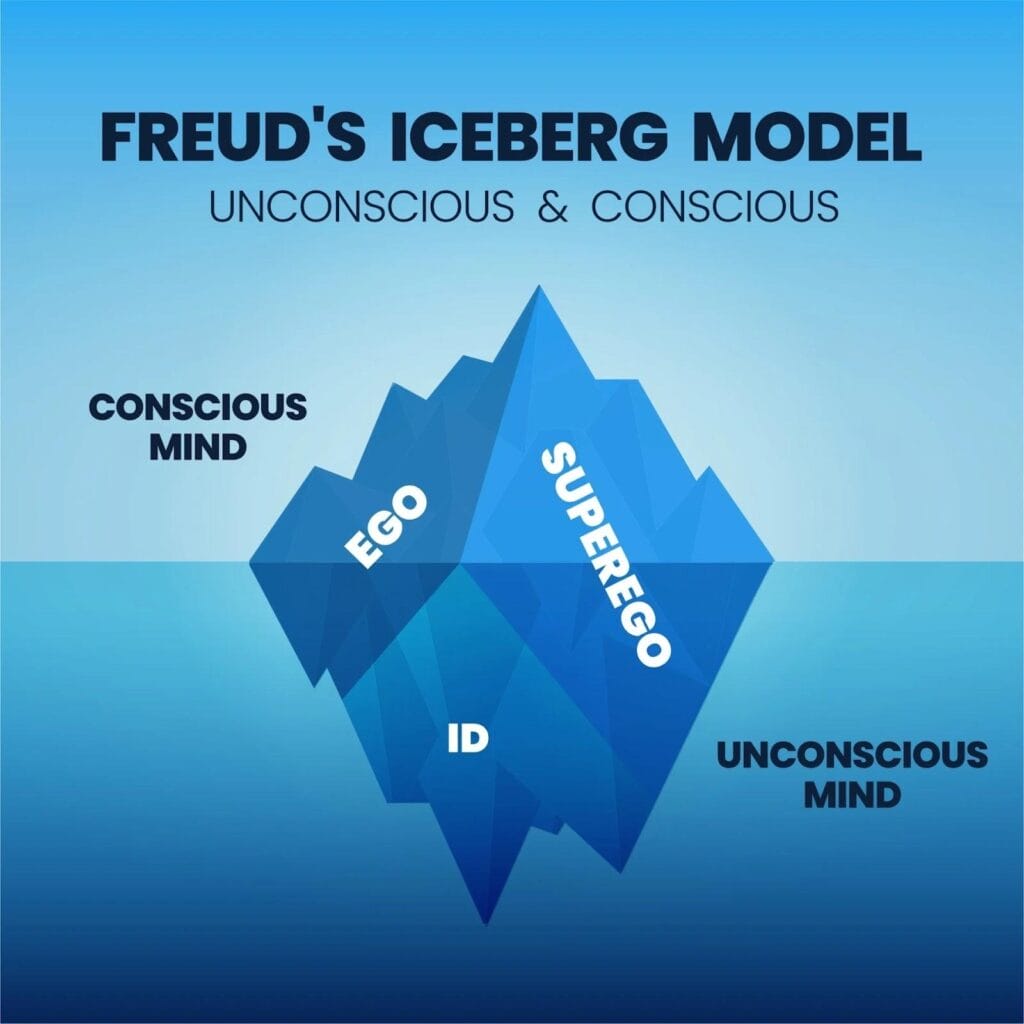
One of the most well-known contributions of Freudian psychology is the three-part model of personality: the Id, Ego, and Superego.
1. The Id
The Id represents instinctual drives and desires, particularly the need for immediate gratification of basic needs such as hunger or sexual urges. It operates from birth and seeks pleasure without considering consequences or social rules. Without the balancing influence of the Ego and Superego, the Id behaves in a primitive and impulsive manner.
2. The Superego
Developing around the age of five, the Superego represents the internalised values, morals, and social expectations learned from caregivers and society. It suppresses the Id’s impulses and rewards moral behaviour through feelings of pride, while punishing perceived wrongdoing through guilt or shame.
3. The Ego
The Ego acts as the mediator between the Id and Superego. It is grounded in reality and works to fulfil the Id’s needs in socially acceptable ways. A common example is delayed gratification, such as waiting until the appropriate time or place to eat when hungry.
Achieving a Healthy Balance
According to Freud, a healthy personality emerges when the Ego maintains balance between the Id and Superego. Challenges occur when:
- The Id dominates: leading to impulsivity, emotional instability, depression, or anxiety
- The Superego dominates: resulting in self-criticism, guilt, or feelings of inadequacy
Saul McLeod (2025) illustrates this structure through an “iceberg model”, where the Id lies hidden beneath the surface while the Ego and Superego are more visible in daily interactions.
Forms of Psychodynamic Therapy
The psychodynamic school consists of multiple approaches that build on Freud’s original concepts.
1. Analytical Therapy (Jungian Approach)
Developed by Carl Jung, analytical therapy is a branch of psychoanalytic practice that uses methods such as dream analysis, symbolic interpretation, and active imagination. Compared with classical psychoanalysis, it is generally less intensive, involving fewer and shorter sessions. It emphasises integrating unconscious material to create a more unified sense of self.
2. Object Relations Therapy
Founded by Melanie Klein, object relations theory focuses on how early relationships with caregivers shape a person’s internal world and influence later interactions and attachment patterns.
If early bonds are stable and nurturing, individuals tend to develop trust and emotional security. However, unstable or inconsistent early relationships can lead to difficulties in forming healthy attachments later in life. Object relations concepts can also apply to a wide range of issues, including specific phobias.
References
American Psychoanalytic Association. (n.d.). When to see a psychoanalyst. https://apsa.org/when-to-see-a-psychoanalyst/
APA Monitor. (2017). Psychoanalysis in the modern world. https://www.apa.org/monitor/2017/12/psychoanalysis-psychodynamic
BluePrint. (n.d.). Psychodynamic therapy: Examples, tools, and techniques. https://www.blueprint.ai/blog/psychodynamic-therapy-examples-tools-and-techniques
Cleveland Clinic. (n.d.). What is the ego? https://my.clevelandclinic.org/health/articles/what-is-the-ego
Complete Psychology. (n.d.). How psychodynamic, CBT & third wave therapies differ: A guide. https://www.complete-psychology.com/how-psychodynamic-cbt-third-wave-therapies-differ-a-guide/
EBSCO. (n.d.). Object relations theory. https://www.ebsco.com/research-starters/psychology/object-relations-theory
Medium. (n.d.). The perils of an overactive superego: Why being too strict on yourself leads to depression. https://medium.com/@pinna-skite/the-perils-of-an-overactive-superego-why-being-too-strict-on-yourself-leads-to-depression-and-26e1dc0d9c25
National Center for Biotechnology Information. (n.d.). Psychodynamic therapy. https://www.ncbi.nlm.nih.gov/books/NBK279297/
Opland, C., & Torrico, T. J. (2025). Psychodynamic therapy. In StatPearls. StatPearls Publishing. https://www.ncbi.nlm.nih.gov/sites/books/NBK606117/
Online Learning College. (n.d.). The structure of personality. https://online-learning-college.com/knowledge-hub/mental-health/structure-of-personality/
PositivePsychology.com. (n.d.). Psychodynamic therapy. https://positivepsychology.com/psychodynamic-therapy/#hero-single
PositivePsychology.com. (n.d.). Types of therapies. https://positivepsychology.com/types-of-therapies/#what-are-the-different-therapy-modalities
Psych Associates of Denver. (n.d.). Exploring psychodynamic therapy: A path to self-awareness. https://psychassociatespa.com/exploring-psychodynamic-therapy-a-path-to-self-awareness/
Psychology Today. (n.d.). Freudian psychology. https://www.psychologytoday.com/us/basics/freudian-psychology
PsychologyWriting.com. (n.d.). Freudian and neo-Freudian views on personality. https://psychologywriting.com/freudian-and-neo-freudian-views-on-personality/
Simply Psychology. (n.d.). The psyche: Id, ego, and superego. https://www.simplypsychology.org/psyche.html
Verywell Mind. (n.d.). The id, ego, and superego. https://www.verywellmind.com/the-id-ego-and-superego-2795951
Verywell Mind. (n.d.). What is latent content? https://www.verywellmind.com/what-is-latent-content-2795330
More Posts