Book Your Appointment


Cognitive Behavioural Therapy (CBT)
by Jumana Raggam
December 8, 2025

Cognitive Behavioural Therapy (CBT), developed by Aaron Beck, is based on the idea that our thoughts, emotions, and behaviours are closely interconnected. Beck observed that many clients had distorted thinking patterns that influenced their feelings and actions.
CBT identifies three main cognitive components:
- Automatic thoughts refers to the immediate reactions and emotions that follow an event.
- Cognitive distortions are unhelpful thinking patterns such as overgeneralisation, emotional reasoning or others that shape negative interpretations of experiences.
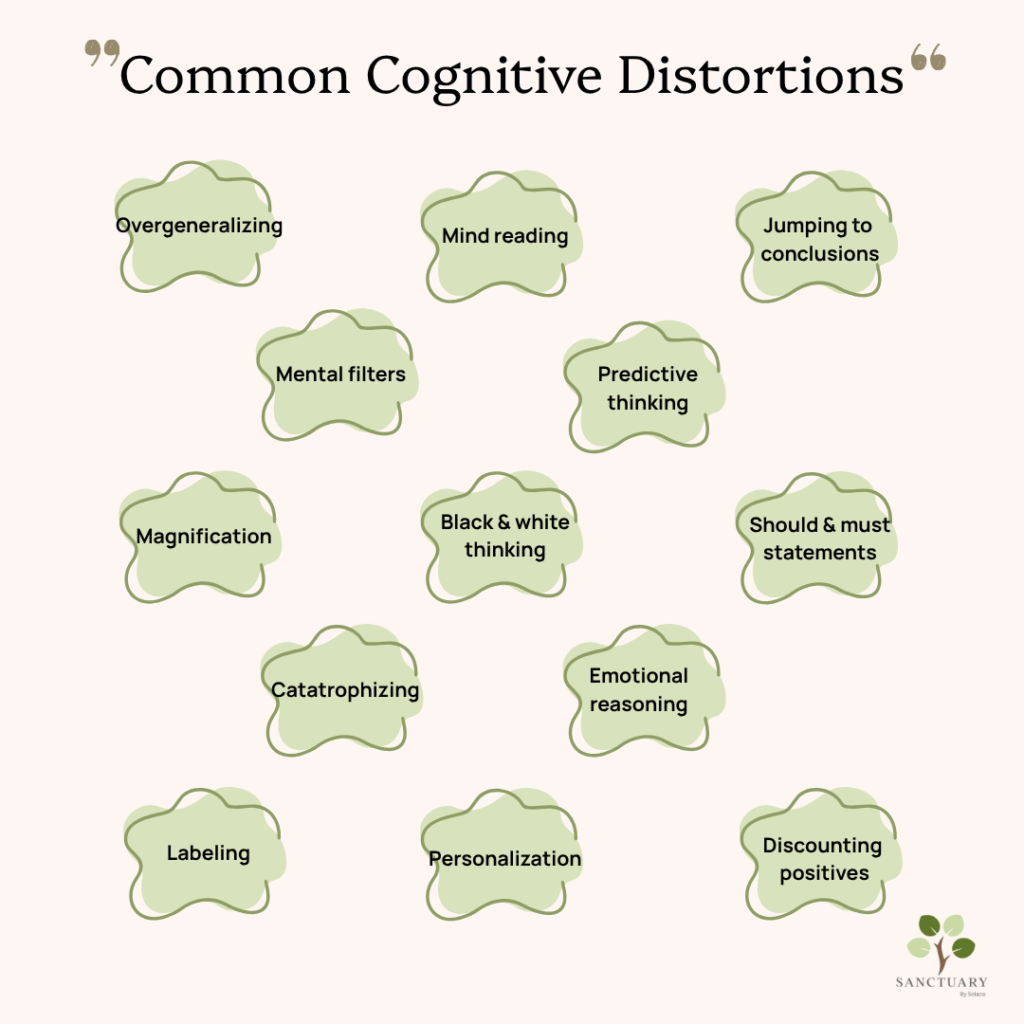
- Underlying beliefs are deep-rooted assumptions or “rules” about life that influence perception and behaviour. Identifying these is key to long-term change.
In CBT, clients learn to recognize and challenge distorted thoughts, understand others’ behaviours more accurately, and develop problem-solving and coping skills. The approach is structured, short-term, and focuses on present difficulties rather than past causes. Through therapist-guided exercises and tailored homework, clients gain the tools and independence to manage their thoughts and behaviours effectively.
Third-wave CBT Approaches
Following the development of the CBT model, newer approaches began to emphasize acceptance, mindfulness, and value-based living as key components of change:
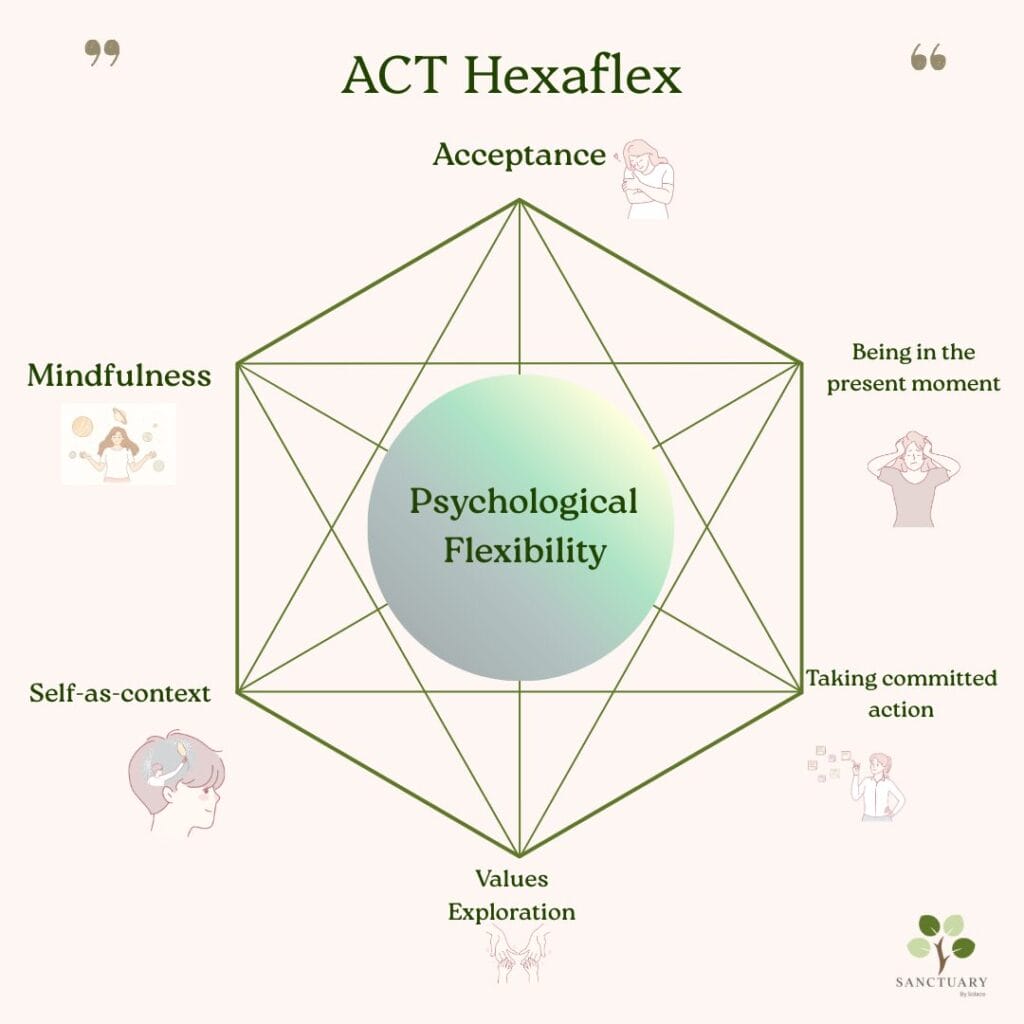
Acceptance and Commitment Therapy (ACT) encourages clients to embrace uncomfortable thoughts and emotions instead of avoiding or suppressing them. Through mindfulness practices, clients learn to observe their experiences without judgment and align their actions with personal values explored in therapy. This fosters self-acceptance and commitment to meaningful life changes.
The ACT approach consists of six main components, often referred to as the hexaflex, that are used to achieve acceptance, mindfulness, exploration of values, and commitment to take and maintain action, ultimately reaching psychological flexibility and resilience.
Dialectical Behaviour Therapy (DBT) integrates techniques from both CBT and ACT. It provides clients with emotion regulation and problem-solving skills, encourages them to approach situations with a balanced perspective, and incorporates mindfulness to manage distress. Unlike traditional CBT, DBT focuses first on intense emotions, helping clients understand and regulate them to develop healthier thought patterns and behaviours. DBT consists of four components that help clients in regulating their emotions, and while some recommend starting with mindfulness, the order of treatment can be tailored to the client’s needs.
Mindfulness trains to focus on the present moment, redirecting from unwanted thoughts and letting go of any judgements that perpetuate uncomfortable emotions. It also trains to label emotions as they are and learn how to make judgements wisely. Distress tolerance is next, and its main purpose is to provide alternative ways to reduce uncomfortable emotions in the moment without turning to harmful or regrettable actions. One technique is the STOP, and the acronym means to:
- S: stop everything and do not react impulsively
- T: take a step back and take deep breath to calm your emotions
- O: observe the external environment and your internal emotions and thoughts. Notice them without judgement
- P: proceed mindfully by thinking about your goals about the situation. Make a plan and conscious decision on the best outcome for the event that triggered your emotions.
Emotional regulation follows, and it goes deeper into understanding your emotions, their triggers, and learning how to act on your emotions. Lastly, an important component is interpersonal effectiveness, especially for those who have trouble maintaining boundaries or often face relationship issues.
Mindfulness-Based Cognitive Therapy (MBCT) shares CBT’s structure but places greater emphasis on present-moment awareness. Clients learn to identify unhelpful thoughts and let them pass without reacting to them. This approach is particularly effective for preventing relapse in depression and promoting emotional resilience.
Mindfulness, across these approaches, involves paying deliberate attention to one’s thoughts, feelings, and sensations in the present moment, with an attitude of curiosity and non-judgment. It helps individuals break free from automatic negative thinking and cultivate a more balanced, compassionate awareness of themselves.
References
Better Health Channel. (n.d.). Cognitive behaviour therapy (CBT). https://www.betterhealth.vic.gov.au/health/conditionsandtreatments/cognitive-behaviour-therapy
Chand, S. P., Kuckel, D. P., & Huecker, M. R. (2025). Cognitive behavior therapy. In StatPearls. StatPearls Publishing. https://www.ncbi.nlm.nih.gov/books/NBK470241/
Cleveland Clinic. (n.d.). Acceptance and Commitment Therapy (ACT). https://my.clevelandclinic.org/health/treatments/acceptance-and-commitment-therapy-act-therapy
Cleveland Clinic. (n.d.). Dialectical behaviour therapy (DBT). https://my.clevelandclinic.org/health/treatments/22838-dialectical-behavior-therapy-dbt
Dialectical Behavior Therapy. (n.d.). Distress tolerance. https://dialecticalbehaviortherapy.com/distress-tolerance/
Dialectical Behavior Therapy. (n.d.). Emotion regulation. https://dialecticalbehaviortherapy.com/emotion-regulation/
Dialectical Behavior Therapy. (n.d.). Interpersonal effectiveness. https://dialecticalbehaviortherapy.com/interpersonal-effectiveness/
Dialectical Behavior Therapy. (n.d.). Mindfulness. https://dialecticalbehaviortherapy.com/mindfulness/
Dindo, L., Van Liew, J. R., & Arch, J. J. (2017). Acceptance and Commitment Therapy: A transdiagnostic behavioural intervention for mental health and medical conditions. Neurotherapeutics, 14(3), 546–553. https://doi.org/10.1007/s13311-017-0521-3
Medical News Today. (n.d.). Acceptance and Commitment Therapy (ACT): Overview. https://www.medicalnewstoday.com/articles/act-therapy#overview
Mayo Clinic. (n.d.). Cognitive behavioural therapy. https://www.mayoclinic.org/tests-procedures/cognitive-behavioral-therapy/about/pac-20384610
PositivePsychology.com. (n.d.). ACT model. https://positivepsychology.com/act-model/
PositivePsychology.com. (n.d.). Types of therapies. https://positivepsychology.com/types-of-therapies/#what-are-the-different-therapy-modalities
More Posts